

Japan Semiconductor Device Market Size, Share & Forecast USD 95.82 Billion by 2035 at 4.65% CAGR
Japan Semiconductor Device Market
Japan Semiconductor Device Market Size, Share and Research Report By Device Type (Discrete Semiconductors, Optoelectronics, Sensors, Integrated Circuits
The Japan Semiconductor Device Market is strengthening through continuous investments in chip manufacturing, AI technologies, automotive electronics, and next-generation semiconductor innovation.”
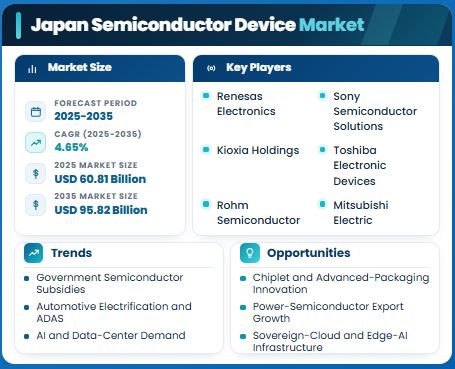
TOKYO, TOKYO, JAPAN, July 6, 2026 /EINPresswire.com/ -- The Japan semiconductor device market reached an estimated USD 60.81 billion in 2025 and is projected to grow from USD 63.64 billion in 2026 to USD 95.82 billion by 2035, registering a CAGR of 4.65% during the forecast period. — Market Research Future (MRFR)
Two major catalysts are accelerating this trajectory: Japan’s landmark national semiconductor revitalization strategy backed by over USD 13 billion in government subsidies anchored by the Rapidus 2nm fab initiative and TSMC’s Kumamoto expansion and surging domestic demand for advanced logic chips, power semiconductors, and image sensors driven by automotive electrification and AI infrastructure buildout. With Japan’s semiconductor output targeted to double by 2030 under the national chip policy framework, device manufacturers and tier-1 equipment suppliers face a once-in-a-generation opportunity to recapture global market leadership.
Legacy planar CMOS process nodes many still running on 28nm and older geometries at domestic fabs are rapidly giving way to advanced packaging, compound semiconductor, and next-generation power device platforms that integrate GaN-on-Si, SiC MOSFETs, and 3D-stacked logic architectures. A recent METI industry survey estimated that top-quartile Japanese device manufacturers investing in advanced node transitions and chiplet integration achieved 21–26% greater gross margin improvement than peers maintaining conventional monolithic process strategies. This transformation is not incremental it represents a structural re-platforming of Japan’s entire semiconductor value chain.
Get Full PDF Sample Copy of Report: (Including Full TOC, List of Tables & Figures, Chart) @
https://www.marketresearchfuture.com/sample_request/21777
➤ How Significant Is the Japan Semiconductor Device Market’s Growth?
The Japan semiconductor device market has demonstrated consistent and robust expansion, rising from approximately USD 48.7 billion in 2021 to an estimated USD 60.81 billion in 2025, representing a healthy historical growth trajectory. The market is expected to nearly double over the next decade, driven by the convergence of government-backed fab investment, automotive semiconductor demand, and Japan’s unique strength in specialty and analog device categories.
Surging adoption of silicon carbide (SiC) and gallium nitride (GaN) power devices in electric vehicle powertrains, onboard chargers, and EV charging infrastructure where Japanese automotive suppliers hold dominant global positions has created acute demand for domestic advanced power semiconductor production. Automotive OEMs, industrial robotics manufacturers, data center operators, and consumer electronics companies are all investing heavily in Japan’s semiconductor ecosystem to secure supply chain resilience and reduce geopolitical exposure.
➤ What Does the Future Hold for the Japan Semiconductor Device Market?
Advanced logic and memory device development stands at the forefront of the market’s next growth phase. Japan’s Rapidus consortium targeting 2nm-class logic production by the late 2020s in partnership with IBM and imec represents the nation’s most ambitious re-entry into leading-edge logic fabrication in over two decades. Simultaneously, Kioxia and Western Digital’s joint NAND flash operations in Yokkaichi and Kitakami continue to rank among the world’s most advanced 3D NAND production facilities.
The growing emphasis on compound semiconductors and power electronics is another defining force shaping the market’s future. Japan’s entrenched strengths in SiC substrate manufacturing with firms such as Rohm, Mitsubishi Electric, and Fuji Electric holding leading global positions in SiC MOSFET production position the country to capture an outsized share of the rapidly expanding EV powertrain and renewable energy inverter device markets through 2035.
Chiplet architecture and advanced heterogeneous integration are also redefining Japan’s device roadmap. With domestic materials and equipment suppliers such as Shin-Etsu Chemical, SUMCO, Tokyo Electron, and Shin-Etsu MicroSi holding critical positions in the global semiconductor supply chain, Japan is uniquely positioned to co-develop next-generation packaging and interconnect technologies alongside its device manufacturing partners.
➤ Who Are the Key Players in the Japan Semiconductor Device Market?
The Japan semiconductor device landscape is characterized by a mix of globally dominant IDMs, specialized analog and power device manufacturers, and emerging fab consortia. Key participants shaping the competitive dynamics include:
• Toshiba Electronic Devices & Storage
• Rohm Semiconductor
• Renesas Electronics
• Sony Semiconductor Solutions
• Murata Manufacturing
• Mitsubishi Electric
• Fuji Electric
• Kioxia Holdings
• Rapidus Corporation
• Infineon Technologies Japan
Competition in the market is intensifying as domestic IDMs race to accelerate SiC and GaN device roadmaps, global foundries expand Japanese fab footprints with government co-investment, and chiplet ecosystem alliances redefine how logic, memory, and analog functions are integrated. Strategic co-development agreements with Japanese automotive OEMs, industrial conglomerates, and AI infrastructure developers are also reshaping the competitive landscape.
➤ What Are the Emerging Trends in the Japan Semiconductor Device Market?
Several transformational trends are redefining how the Japan semiconductor device market evolves through 2035:
Government-Led Fab Revitalization: METI’s semiconductor industrial policy channeling over USD 13 billion in direct subsidies through Rapidus, the TSMC Kumamoto joint venture (JASM), and Micron’s Hiroshima DRAM expansion is fundamentally restructuring Japan’s position in the global fab hierarchy.
SiC & GaN Power Device Leadership: Japanese device manufacturers hold commanding global positions in SiC MOSFET and GaN-on-Si power device markets, with demand accelerating as EV penetration in Japan, Europe, and China approaches inflection points across 2025–2030.
Automotive Semiconductor Integration: The transition to software-defined vehicles (SDVs) and centralized zonal E/E architectures is driving demand for high-performance automotive SoCs, power management ICs, and radar/LiDAR sensor semiconductors areas where Japanese suppliers hold deep application expertise.
AI & Edge Inference Devices: Japanese device firms are investing in neuromorphic computing architectures, in-memory computing solutions, and low-power edge AI inference chips targeting robotics, industrial automation, and IoT endpoints markets where Japan holds strong end-customer relationships.
Advanced Packaging & Heterogeneous Integration: Japanese materials and equipment leaders are co-developing glass substrates, hybrid bonding interconnects, and fan-out wafer-level packaging technologies that position domestic supply chains at the center of next-generation chiplet assembly ecosystems.
Supply Chain Resilience & Geopolitical Realignment: Japan’s strategic positioning as a trusted semiconductor manufacturing partner for the US, EU, and Indo-Pacific allies is driving accelerated fab investment, preferential procurement agreements, and joint R&D programs that structurally reinforce domestic device production capacity.
Get access to the full description of the report @ h
ttps://www.marketresearchfuture.com/reports/japan-semiconductor-device-market-21777
➤ How Is the Japan Semiconductor Device Market Segmented?
The Japan semiconductor device market report provides a comprehensive segmentation framework:
By Device Type: Logic Devices, Memory Devices, Analog & Mixed-Signal ICs, Microcontrollers & Microprocessors, Power Semiconductors, Discrete Devices, Optoelectronics & Sensors
By Material: Silicon (Si), Silicon Carbide (SiC), Gallium Nitride (GaN), Gallium Arsenide (GaAs), Indium Phosphide (InP)
By End-Use Vertical: Automotive & EV, Consumer Electronics, Industrial Automation & Robotics, Data Centers & AI Infrastructure, Telecommunications, Healthcare & Medical Devices, Defense & Aerospace
By Fabrication Model: Integrated Device Manufacturer (IDM), Fabless Design, Foundry Services, OSAT (Outsourced Semiconductor Assembly & Test)
By Node Technology: Mature Nodes (28nm and above), Advanced Nodes (7nm–16nm), Leading-Edge Nodes (Below 7nm)
➤ What Are the Regional Insights from the Japan Semiconductor Device Market?
Kanto & Chubu (Greater Tokyo – Nagoya Corridor) commands the largest share of Japan’s semiconductor device activity, anchored by Renesas’ design centers, Murata’s component operations, and a dense ecosystem of automotive semiconductor application engineers supporting Toyota, Honda, and their tier-1 supply chains. The region’s deep integration between device designers and automotive OEM R&D centers creates a uniquely powerful co-development environment.
Kyushu (Silicon Island) holds the second-largest concentration of semiconductor manufacturing capacity, home to TSMC’s JASM fab in Kumamoto, Sony Semiconductor’s Nagasaki image sensor facilities, and a well-established ecosystem of equipment suppliers, materials processors, and specialty chemical producers. The region is experiencing its most significant capacity expansion in decades, with multiple fab construction projects underway simultaneously.
Tohoku represents a rapidly expanding semiconductor cluster, anchored by Kioxia and Micron’s advanced NAND flash and DRAM production facilities in Kitakami and Hiroshima respectively. Government-backed infrastructure investments are enhancing the region’s attractiveness for further fab development, with access to abundant clean water, renewable energy, and a skilled technical workforce.
Hokkaido is projected to emerge as Japan’s most strategically significant new semiconductor region through 2035. Rapidus’ Chitose fab targeting 2nm-class logic production anchors a planned semiconductor innovation cluster backed by METI and designed to attract co-located R&D, EDA, and packaging ecosystem partners. Hokkaido’s cool climate, green energy resources, and land availability make it uniquely suited for next-generation fab operations.
Kinki (Osaka-Kyoto-Kobe) rounds out the national picture, with Rohm’s SiC device headquarters, Murata’s R&D operations, and a concentration of advanced materials and specialty chemical producers supporting both domestic and global semiconductor supply chains.
➤➤➤ Industry Analysis Reports by Market Research Future:
Hard Disk Market-
https://www.marketresearchfuture.com/reports/hard-disk-market-8306
Outdoor Lighting Market-
https://www.marketresearchfuture.com/reports/outdoor-lighting-market-8340
Pmoled Market-
https://www.marketresearchfuture.com/reports/pmoled-market-8387
Fluorescent Lighting Market-
https://www.marketresearchfuture.com/reports/fluorescent-lighting-market-8501
Discrete Semiconductor Market-
https://www.marketresearchfuture.com/reports/discrete-semiconductor-market-8597
Indoor Farming Robots Market-
https://www.marketresearchfuture.com/reports/indoor-farming-robots-market-8616
Infrared Sensor Market-
https://www.marketresearchfuture.com/reports/infrared-sensor-market-8625
Education Pc Market-
https://www.marketresearchfuture.com/reports/education-pc-market-8660
Smartphone Sensors Market-
https://www.marketresearchfuture.com/reports/smartphone-sensors-market-8709
Industrial Radiography Market-
https://www.marketresearchfuture.com/reports/industrial-radiographys-market-10022
Sagar Kadam
Market Research Future
+ +1 628-258-0071
email us here
Legal Disclaimer:
EIN Presswire provides this news content "as is" without warranty of any kind. We do not accept any responsibility or liability for the accuracy, content, images, videos, licenses, completeness, legality, or reliability of the information contained in this article. If you have any complaints or copyright issues related to this article, kindly contact the author above.
