

Satellite IoT Market Driven by Digital Transformation and Smart Industry Adoption
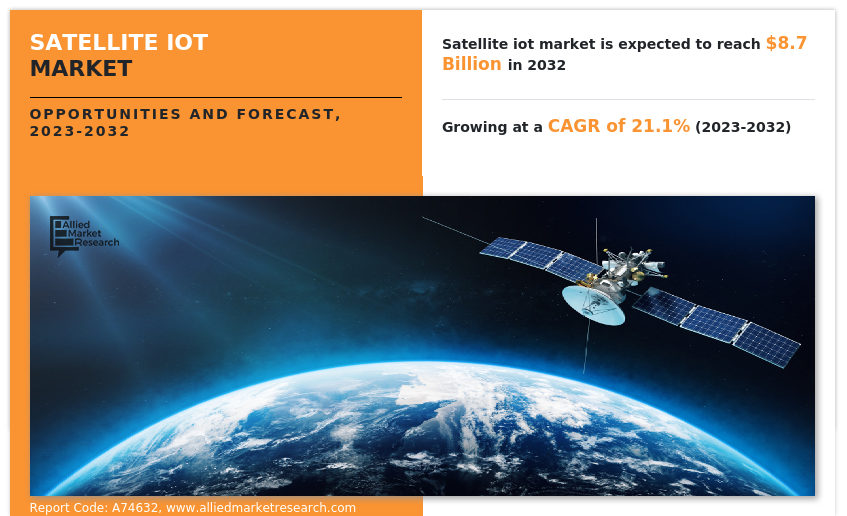
Satellite IoT market is projected to reach $8.7 billion by 2032, driven by digitalization and global connectivity demand.
Growing adoption of IoT, AI, and cloud technologies boosts satellite IoT market growth across industries worldwide.”
WILMINGTON, DE, UNITED STATES, June 3, 2026 /EINPresswire.com/ -- — Allied Market Research
According to a report published by Allied Market Research, the satellite IoT market size was valued at $1.3 billion in 2022 and is projected to reach $8.7 billion by 2032, registering a CAGR of 21.1% from 2023 to 2032. The rapid expansion of connected devices, growing digitalization across industries, and increasing demand for reliable communication in remote locations are among the key factors fueling market growth.
The satellite IoT market is becoming an essential part of the global digital ecosystem as businesses increasingly seek connectivity solutions that extend beyond the reach of traditional terrestrial networks. Industries operating in remote environments, including oil and gas, agriculture, maritime, logistics, mining, and defense, are turning to satellite-enabled IoT solutions to ensure continuous monitoring, communication, and data transmission.
Download PDF Brochure: https://www.alliedmarketresearch.com/request-sample/A74632
As governments and enterprises continue investing in advanced technologies such as artificial intelligence, cloud computing, machine learning, and smart infrastructure, the satellite IoT market is expected to experience significant growth over the coming decade.
Understanding Satellite IoT and Its Growing Importance
Satellite IoT refers to the integration of satellite communication networks with Internet of Things (IoT) devices, sensors, and connected systems. Unlike traditional IoT solutions that depend primarily on cellular or terrestrial communication networks, satellite IoT enables devices to communicate directly through satellites, ensuring uninterrupted connectivity regardless of geographic location.
This technology is particularly valuable in areas where conventional communication infrastructure is unavailable, unreliable, or economically impractical. Remote regions, offshore locations, mountainous terrain, deserts, forests, and vast oceanic areas often lack adequate cellular coverage. Satellite IoT bridges this connectivity gap by providing seamless communication capabilities across virtually any location on the planet.
The increasing affordability of satellite communication services has made satellite IoT more accessible to businesses of all sizes. As satellite constellations expand and launch costs decline, organizations are finding it easier to deploy large-scale IoT networks that support operational efficiency, asset tracking, environmental monitoring, and predictive maintenance initiatives.
Growing Demand for Global Connectivity Driving Market Expansion
One of the primary drivers of the satellite IoT market is the growing need for global connectivity. Businesses today operate across geographically dispersed locations and require continuous access to real-time operational data. Traditional communication networks often struggle to provide reliable coverage in remote environments, creating opportunities for satellite-based solutions.
Satellite IoT enables organizations to monitor equipment, vehicles, infrastructure, and environmental conditions from virtually anywhere. This capability is particularly important for industries such as maritime shipping, oil exploration, mining operations, and utility management, where assets are frequently located far from urban centers.
The ability to maintain uninterrupted communication regardless of location allows companies to improve productivity, reduce operational risks, and enhance decision-making capabilities. As global industries continue expanding into remote regions, demand for satellite IoT solutions is expected to rise substantially.
Digital Transformation Accelerating Satellite IoT Adoption
The ongoing digital transformation across industries is playing a significant role in satellite IoT market growth. Organizations are increasingly adopting advanced technologies to automate processes, optimize operations, and gain deeper insights into business performance.
Satellite IoT serves as a critical enabler of digital transformation initiatives by facilitating data collection and communication across geographically distributed assets. Real-time monitoring capabilities allow businesses to improve operational visibility, reduce downtime, and respond quickly to emerging issues.
The integration of satellite IoT with artificial intelligence, machine learning, and cloud-based analytics platforms further enhances its value. These technologies enable organizations to process vast amounts of operational data, identify patterns, predict failures, and implement proactive maintenance strategies.
As businesses continue investing in smart technologies, the demand for scalable and reliable satellite IoT solutions is expected to grow significantly.
Role of Satellite IoT in Remote Industrial Operations
Many industries rely heavily on operations located in remote and challenging environments. Oil and gas companies, for example, often operate drilling rigs, pipelines, and production facilities in offshore locations or isolated regions where terrestrial communication infrastructure is limited.
Satellite IoT provides these organizations with continuous visibility into equipment performance, environmental conditions, and operational activities. This connectivity helps improve safety, reduce operational costs, and enhance asset utilization.
Mining companies also benefit from satellite IoT by monitoring machinery, workforce activities, and environmental compliance in remote mining sites. Similarly, utility providers use satellite IoT to monitor power infrastructure, water systems, and renewable energy installations located in hard-to-reach areas.
The increasing need for operational efficiency and real-time data access continues to strengthen demand for satellite IoT across industrial sectors.
Increasing Investments in Advanced Technologies Creating Opportunities
Growing investments in emerging technologies are creating favorable conditions for satellite IoT market expansion. Governments and private organizations are allocating significant resources toward artificial intelligence (AI), machine learning, cloud computing, business intelligence, and advanced communication networks.
Satellite IoT solutions are increasingly being integrated with these technologies to create intelligent ecosystems capable of delivering actionable insights and automated decision-making capabilities. Businesses are leveraging connected devices to gather data from remote assets and transmit information through satellite networks to centralized analytics platforms.
This integration allows organizations to improve operational efficiency, enhance customer experiences, and support strategic business initiatives. As technological innovation continues to accelerate, satellite IoT is expected to become an increasingly important component of digital infrastructure worldwide.
Procure This Report (469 Pages PDF with Insights, Charts, Tables, and Figures): https://www.alliedmarketresearch.com/satellite-iot-market/purchase-options
Challenges Restricting Market Growth
Despite its strong growth potential, the satellite IoT market faces several challenges that may impact adoption rates. One of the most significant barriers is the relatively high cost associated with satellite communication infrastructure and services.
Although satellite technology has become more affordable in recent years, deployment and operational costs can still be higher than traditional terrestrial communication solutions. Small and medium-sized enterprises may face budget constraints when implementing large-scale satellite IoT networks.
Regulatory complexities also present challenges for market participants. Satellite communications are subject to various national and international regulations governing spectrum allocation, licensing requirements, and data security standards. Navigating these regulatory frameworks can increase deployment timelines and operational complexity.
In addition, the absence of comprehensive government policies related to satellite IoT in certain regions may create uncertainty for businesses seeking to invest in these technologies.
Cloud Computing and Emerging Technologies Supporting Growth
The growing adoption of cloud computing is creating significant opportunities within the satellite IoT market. Cloud platforms provide scalable infrastructure for storing, processing, and analyzing large volumes of IoT-generated data.
Satellite IoT devices can transmit information directly to cloud-based systems, enabling organizations to access real-time operational insights from any location. This capability supports advanced applications such as predictive maintenance, asset tracking, supply chain optimization, and remote diagnostics.
Emerging technologies including augmented reality and virtual reality are also contributing to market growth. These technologies rely on continuous connectivity and real-time data exchange, making satellite IoT an attractive solution for organizations operating in remote environments.
As digital ecosystems become increasingly interconnected, satellite IoT is expected to play a crucial role in supporting next-generation business applications.
Industry Vertical Analysis
The oil and gas sector represented the largest share of the satellite IoT market in 2022. Oil and gas companies operate extensive infrastructure networks that require constant monitoring and management. Satellite IoT solutions help improve operational efficiency, enhance worker safety, and reduce maintenance costs across upstream, midstream, and downstream operations.
The agriculture sector is expected to witness the fastest growth during the forecast period. Farmers are increasingly adopting satellite IoT technologies to support precision agriculture initiatives, monitor crop health, manage irrigation systems, and track environmental conditions.
Agricultural operations often span large geographic areas where terrestrial communication networks are limited. Satellite IoT enables farmers to collect and analyze data from remote fields, helping optimize productivity while reducing resource consumption.
Other key industries adopting satellite IoT include maritime transportation, defense and military, logistics, utilities, environmental monitoring, and mining.
Service Type Insights
Based on service type, the direct-to-satellite segment generated the highest revenue in 2022. Direct-to-satellite communication enables IoT devices to connect directly with satellites without relying on intermediate terrestrial infrastructure.
This approach simplifies network architecture and provides reliable connectivity in remote regions. As satellite technology continues to evolve, direct-to-satellite solutions are expected to become increasingly popular across multiple industries.
The satellite IoT backhaul segment is also anticipated to experience substantial growth. Backhaul services connect local communication networks to broader data transmission infrastructure, enabling seamless information exchange between remote locations and centralized systems.
Frequency Band Analysis
The L-band segment is expected to maintain a significant position within the satellite IoT market due to its reliability and ability to perform effectively under adverse weather conditions. L-band frequencies are widely used for mobile satellite communications and support a variety of IoT applications.
Meanwhile, Ku-band and Ka-band technologies are projected to witness rapid growth during the forecast period. These frequency bands offer higher data transmission speeds and greater bandwidth capacity, making them suitable for advanced IoT applications requiring substantial data throughput.
As demand for high-performance satellite communication services increases, adoption of Ku-band and Ka-band solutions is expected to accelerate.
Regional Outlook
North America accounted for the largest share of the satellite IoT market in 2022. The region benefits from strong technological infrastructure, substantial investments in digital transformation, and widespread adoption of advanced technologies including cloud computing, artificial intelligence, machine learning, and IoT.
The presence of major satellite communication providers and technology companies further supports market growth throughout the region.
Asia-Pacific is expected to register the highest growth rate during the forecast period. Rapid digitalization, increasing internet penetration, expanding industrial sectors, and government support for technology innovation are creating favorable conditions for satellite IoT adoption.
Countries such as China, India, Japan, South Korea, and Australia are investing heavily in smart infrastructure, telecommunications, and satellite communication technologies. These investments are expected to drive significant market opportunities across the Asia-Pacific region.
Europe is also projected to experience substantial growth as organizations increasingly embrace connected technologies and digital transformation strategies.
Competitive Landscape
The satellite IoT market is highly competitive, with leading companies focusing on technological innovation, partnerships, acquisitions, and product development initiatives to strengthen their market positions.
Major industry participants include ORBCOMM, Iridium Communications Inc., Inmarsat, Airbus, Astrocast, Intelsat, Globalstar, Thales, OQ Technology, and Eutelsat Communications.
These organizations are actively pursuing strategic collaborations, technology partnerships, acquisitions, and service innovations to expand their global footprint and capture emerging market opportunities.
Get a Customized Research Report: https://www.alliedmarketresearch.com/request-for-customization/A74632
Future Outlook
The future of the satellite IoT market appears exceptionally promising as industries increasingly require reliable, global connectivity solutions. Rising adoption of connected devices, growing investments in digital transformation, and expanding applications across sectors such as agriculture, energy, logistics, defense, and utilities are expected to sustain strong market growth.
As satellite communication networks become more affordable and technologically advanced, satellite IoT will play an increasingly important role in enabling real-time monitoring, automation, and intelligent decision-making worldwide. With a projected market value of $8.7 billion by 2032, the satellite IoT market is positioned to become a cornerstone of the next generation of connected technologies and global digital infrastructure.
Trending Reports in Energy and Power Industry:
Satellite IoT Market
https://www.alliedmarketresearch.com/satellite-iot-market-A74632
IoT Device Management Market
https://www.alliedmarketresearch.com/iot-device-management-market-A13166
IoT Testing Market
https://www.alliedmarketresearch.com/iot-testing-market-A08127
AI in IoT Market
https://www.alliedmarketresearch.com/ai-in-iot-market-A12590
AIoT Platform Market
https://www.alliedmarketresearch.com/aiot-platform-market-A74838
IoT Integration Market
https://www.alliedmarketresearch.com/iot-integration-market
Iot Identity and Access Management (IAM) Market
https://www.alliedmarketresearch.com/iot-identity-and-access-management-iam-market-A31545
Europe IoT Market
https://www.alliedmarketresearch.com/europe-iot-market-A31587
IoT in Retail Market
https://www.alliedmarketresearch.com/iot-in-retail-market-A13167
IoT in Energy Market
https://www.alliedmarketresearch.com/iot-in-energy-market
IoT Market
https://www.alliedmarketresearch.com/internet-of-things-iot-market
About Us
Allied Market Research (AMR) is a full-service market research and business-consulting wing of Allied Analytics LLP based in Portland, Oregon. Allied Market Research provides global enterprises as well as medium and small businesses with unmatched quality of "Market Research Reports" and "Business Intelligence Solutions." AMR has a targeted view to provide business insights and consulting to assist its clients to make strategic business decisions and achieve sustainable growth in their respective market domain.
Pawan Kumar, the CEO of Allied Market Research, is leading the organization toward providing high-quality data and insights. We are in professional corporate relations with various companies and this helps us in digging out market data that helps us generate accurate research data tables and confirms utmost accuracy in our market forecasting. Each and every data presented in the reports published by us is extracted through primary interviews with top officials from leading companies of domain concerned. Our secondary data procurement methodology includes deep online and offline research and discussion with knowledgeable professionals and analysts in the industry.
David Correa
Allied Market Research
+ + + + + + + + + + + + +1 800-792-5285
email us here
Visit us on social media:
LinkedIn
Facebook
YouTube
X
Legal Disclaimer:
EIN Presswire provides this news content "as is" without warranty of any kind. We do not accept any responsibility or liability for the accuracy, content, images, videos, licenses, completeness, legality, or reliability of the information contained in this article. If you have any complaints or copyright issues related to this article, kindly contact the author above.
