

Feasibility Studies and Business Planning in India Become Critical for Industrial Investments in 2026
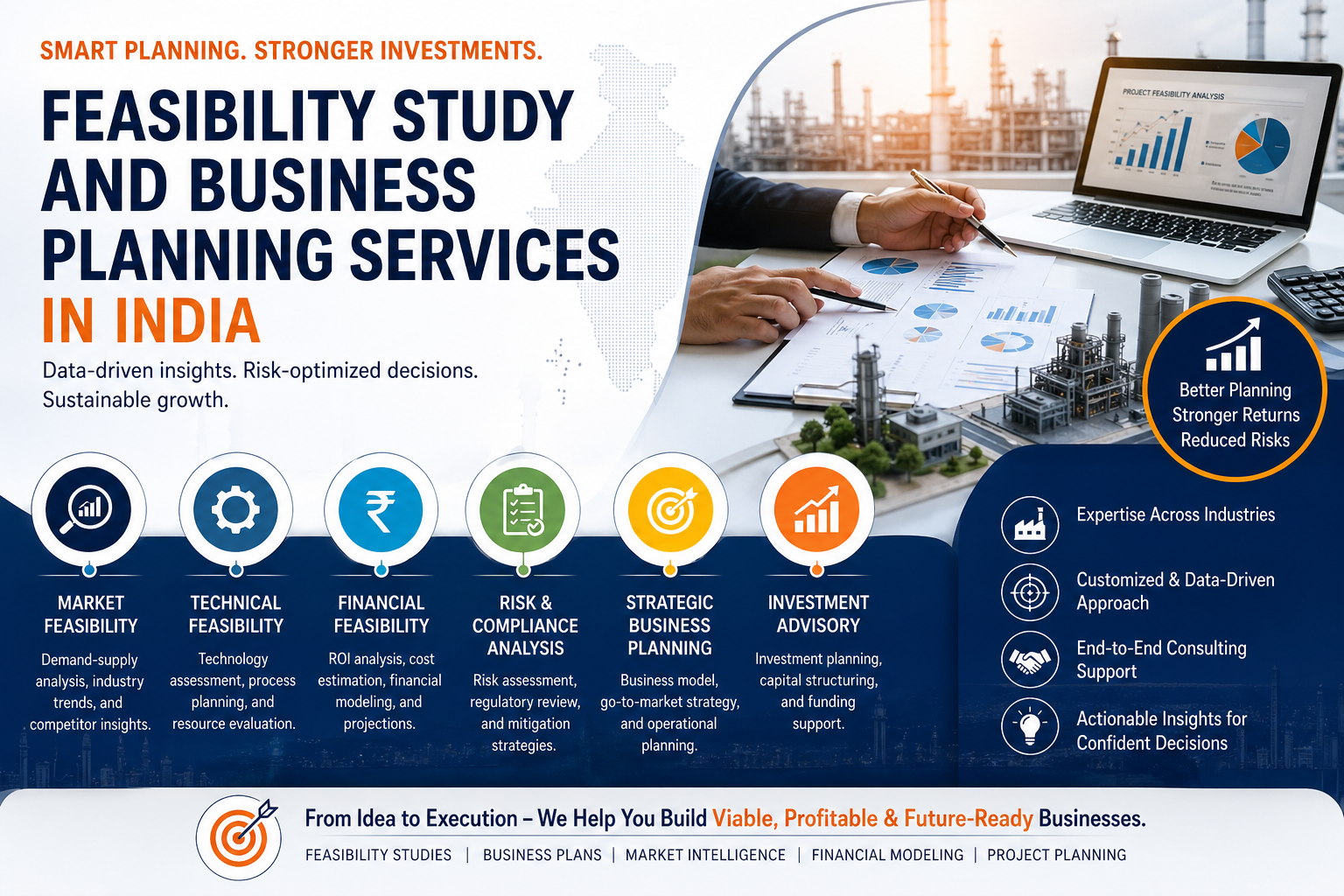
feasibility study and business planning
With rising investments & project failure rates, feasibility studies and structured business planning are key to informed decisions in India’s industrial land.
NOIDA, UTTAR PRADESH, INDIA, April 29, 2026 /EINPresswire.com/ -- India’s industrial economy is entering a high-growth investment phase, with manufacturing contributing 13–17% of GDP and a national target of 25% under the Make in India initiative. Key sectors such as electric vehicles, pharmaceuticals, green hydrogen, food processing, semiconductors, and specialty chemicals are attracting strong domestic and foreign investments. However, nearly 90% of Indian start-ups fail within five years, largely due to weak market validation and inadequate financial planning, highlighting a critical gap between investment ideas and commercially viable projects.In this environment, feasibility studies and structured business planning have become essential risk-management tools rather than optional steps. IMARC Engineering, an EPCM advisory firm based in Noida, supports investors, manufacturers, financial institutions, and government bodies with engineering-led feasibility analysis and bankable business planning, enabling informed and data-driven capital decisions across India.
Why Feasibility Studies Are the First Line of Defence Against Project Failure:
Project failures in India are often driven by well-known issues, including unrealistic financial projections, weak market research, underestimated regulatory complexity, and inadequate technical evaluation. A structured feasibility study helps identify and address these risks before any capital is committed.
A manufacturing feasibility study goes beyond financial modelling. It is a comprehensive, multi-dimensional assessment that evaluates market demand, technology viability and scalability, realistic project costs, expected returns, and the project’s ability to meet lender requirements under conservative assumptions.
These insights form the foundation of Detailed Project Reports (DPRs) and bankable feasibility studies required by financial institutions such as the Small Industries Development Bank of India and the National Bank for Agriculture and Rural Development, along with multilateral agencies like the World Bank and the Asian Development Bank.
In practice, many project risks arise when capital cost estimates are based on generic assumptions rather than project-specific engineering. Critical elements such as plant layout, utilities, equipment specifications, and compliance costs are often underestimated. This leads to cost overruns, delayed commissioning, and lower-than-expected returns—issues that could be avoided through rigorous feasibility analysis at the pre-investment stage.
Get a Customized Feasibility Report for Your Project: https://www.imarcengineering.com/contact-us
The Engineering-Led Difference: Why Technical Rigour Drives Financial Accuracy:
IMARC Engineering's approach is distinguished by its engineering-led methodology. While many consulting firms treat feasibility primarily as a financial exercise, IMARC begins with the engineering — process design, equipment selection, plant layout, and utilities planning — because the technical assumptions are what determine the credibility of the financial model.
This integrated approach means that capital expenditure (CapEx) estimates, production assumptions, and operating cost projections reflect how manufacturing plants actually perform, not how they appear in optimistic spreadsheets. Financial models include Net Present Value (NPV) calculations, Internal Rate of Return (IRR) projections, discounted cash flow analysis, payback period assessments, and break-even analysis — all stress-tested through sensitivity scenarios that evaluate the impact of changes in raw material costs, capacity utilisation, product pricing, and market penetration.
IMARC's feasibility reports are structured to meet the due-diligence requirements of lenders and institutional investors. In recent client engagements, this engineering-first methodology has helped identify CapEx misalignments that, if left uncorrected, would have materially eroded project IRR — and has accelerated credit approvals by reducing iterations with lenders' technical reviewers.
Business Planning: Translating Feasibility Insights into Execution Roadmaps:
A feasibility study determines whether a project is viable, while a business plan defines how it will be executed.
A structured business plan builds on feasibility insights to outline the business model, market strategy, revenue streams, cost structure, funding requirements, and risk mitigation approach. In India’s diverse market and regulatory environment, region-specific and sector-focused planning is essential for effective execution.
Financial institutions typically require both feasibility studies and business plans during due diligence. While feasibility validates technical and commercial viability, the business plan demonstrates execution capability—together forming a strong and credible investment case.
Sector-Specific Expertise Across India's High-Growth Industries:
India's manufacturing renaissance is not uniform, it is playing out differently across sectors, each with its own technology landscape, regulatory framework, cost structure, and market dynamics. A feasibility study that applies a generic manufacturing template to a pharmaceutical Good Manufacturing Practice (GMP) facility, a food processing plant, or an agrochemical production unit will produce unreliable conclusions. Sector knowledge is the difference between a study that informs a confident investment decision and one that provides false assurance.
IMARC Engineering's feasibility teams include sector specialists across representative industries:
• Pharmaceutical and Life Sciences: GMP requirements, clean-room design, CDSCO and WHO-GMP compliance pathways, and validation infrastructure
• Food and Beverage Processing: FSSAI compliance, cold-chain requirements, processing-line evaluation, and supply-chain economics
• Chemical and Specialty Chemical Manufacturing: PESO licensing, CPCB consent, effluent treatment systems, and process safety assessments
• Renewable Energy and EV Manufacturing: Solar panel, wind component, battery cell, and electric vehicle manufacturing feasibility aligned with Production Linked Incentive (PLI) scheme economics
• Agrochemical and Fertiliser Plants: Hazard analysis, environmental compliance cost estimation, and storage system planning
• Automotive and Auto Components: IATF 16949/ISO certification requirements, OEM qualification, tooling investment analysis, and EV-parts manufacturing
• Industrial and Heavy Manufacturing: Furnace and kiln technology selection, refractory costs, utility infrastructure, and civil cost assessment
• Emerging Sectors: Semiconductors, advanced materials, data centres, textiles, cement, and steel — evaluated against current PLI and policy frameworks
Validate Your Project Before You Invest - Get a Data-Driven Feasibility Study & Business Plan at: https://www.imarcengineering.com/services/feasibility-study-business-planning
Key Trends Shaping Feasibility and Business Planning Services in India (2026):
• Feasibility studies are evolving rapidly due to technological advancements, expanding regulatory frameworks, and increased investor scrutiny, especially as India targets 25% manufacturing contribution to GDP by 2030.
• AI-driven demand forecasting improves market accuracy and helps reduce planning errors linked to 20–30% project delays in India.
• Digital process simulation enables evaluation of multiple plant configurations, addressing the reality that over 60% of industrial projects face cost overruns due to poor upfront planning.
• ESG considerations, including environmental impact, carbon footprint, and social factors, are becoming central, with regulatory oversight increasing through MoEFCC and State Pollution Control Boards.
• Investors are increasingly requiring sustainability-focused feasibility outputs, as ESG-linked financing and compliance expectations continue to rise globally.
• Policy-driven initiatives such as PLI schemes across 14+ sectors and the ₹111 lakh crore National Infrastructure Pipeline (NIP) are accelerating new project opportunities.
• Feasibility studies must align with government incentives, compliance requirements, and approval timelines to ensure project viability and faster clearances.
From Feasibility to Execution: The Continuity Advantage
One of the most common risks in industrial project development is the gap between feasibility assumptions and on-ground execution. When feasibility is handled separately from project execution, critical technical assumptions, cost structures, and design intent are often lost—leading to scope changes, cost overruns, and performance gaps.
IMARC Engineering addresses this through an integrated service model, supporting clients from feasibility and DPR preparation to engineering design, procurement, regulatory approvals, project management, and commissioning. This continuity ensures that planning assumptions are consistently carried into execution, reducing risks and improving project outcomes.
Investing in Feasibility is Investing in Project De-Risking:
For organisations investing in manufacturing and infrastructure projects in India, the quality of pre-investment analysis plays a critical role in determining project success.
While a feasibility study does not guarantee success, its absence significantly increases the likelihood of cost overruns, delays, and financial underperformance. In an environment of rising investor scrutiny and regulatory complexity, structured feasibility analysis and business planning form the foundation of credible and bankable projects.
About IMARC Engineering:
IMARC Engineering is an EPCM (Engineering, Procurement and Construction Management) advisory firm headquartered in Noida, Uttar Pradesh, India, with a sales office in Brooklyn, New York, USA. The firm delivers end-to-end industrial project solutions — from pre-investment feasibility and business planning through detailed engineering, procurement, project management, and commissioning — across sectors including pharmaceuticals, food processing, chemicals, automotive, renewable energy, and heavy manufacturing.
IMARC Engineering's feasibility studies are structured to meet the requirements of commercial banks, NBFCs, development finance institutions, private equity investors, and multilateral agencies. The firm is independent of equipment vendors, EPC contractors, technology licensors, and lenders, ensuring objective, credible analysis for every client engagement.
Explore Related Advisory Services:
Strengthen your project planning and investment strategy with our specialized consulting services:
• Capex & Opex Planning Support in India - https://www.imarcengineering.com/services/capex-opex-planning-support
• Risk Assessment & Mitigation Planning in India - https://www.imarcengineering.com/services/risk-assesssment-and-mitigation-planning
• Technical Due Diligence for Investors in India - https://www.imarcengineering.com/services/technical-due-diligence-for-investors
• Industrial Licensing & Incentive Advisory in India - https://www.imarcengineering.com/services/industrial-licensing-incentive-advisory
Nikhil Garg
IMARC Engineering
+91 120 433 0800
sales@imarcgroup.com
Legal Disclaimer:
EIN Presswire provides this news content "as is" without warranty of any kind. We do not accept any responsibility or liability for the accuracy, content, images, videos, licenses, completeness, legality, or reliability of the information contained in this article. If you have any complaints or copyright issues related to this article, kindly contact the author above.
