

Ambulatory EHR Market to Reach USD 15.93 Billion by 2034 at 6.07% CAGR (2026–2034)
Ambulatory EHR Market
Global ambulatory EHR market valued at USD 9.47 billion in 2025 is projected to reach USD 15.93 billion by 2034, growing at a CAGR of 6.07%.
The ambulatory EHR market is set to grow from USD 9.47 billion in 2025 to USD 15.93 billion by 2034, driven by outpatient care expansion and digital health adoption.”
PUNE, MAHARASHTRA, INDIA, February 4, 2026 /EINPresswire.com/ -- The global ambulatory EHR market size was valued at USD 9.47 billion in 2025 and is projected to grow from USD 9.94 billion in 2026 to USD 15.93 billion by 2034, exhibiting a CAGR of 6.07% during the forecast period. North America dominated the market with a share of 47.26% in 2025.— Fortune Business Insights
Ambulatory Electronic Health Records (EHR) systems are digital platforms designed specifically for outpatient care environments. These systems enable real-time access to patient medical records, laboratory results, prescriptions, and treatment plans, supporting efficient clinical workflows and continuity of care.
The market is experiencing steady growth as healthcare providers increasingly adopt ambulatory EHRs to improve operational efficiency, regulatory compliance, data interoperability, and patient engagement. Growing outpatient volumes and the shift away from inpatient care models are further accelerating market adoption.
Key players such as Epic Systems Corporation, Oracle, Medical Information Technology, Inc., TruBridge, and Veradigm LLC are focusing on platform innovation, cloud migration, and AI-enabled tools to strengthen their market presence.
Get Free Sample Here: https://www.fortunebusinessinsights.com/enquiry/request-sample-pdf/ambulatory-electronic-health-record-market-100620
Market Dynamics
Market Drivers
Shift Toward Outpatient and Ambulatory Care to Drive Market Growth
The global healthcare system is increasingly transitioning toward outpatient and ambulatory care models due to cost efficiency, patient convenience, and limited inpatient capacity. Ambulatory EHR systems play a critical role in managing high patient volumes, improving care coordination, and enabling real-time clinical decision-making.
Government initiatives promoting outpatient reimbursement and digital adoption further support market expansion, particularly in developed economies.
Market Restraints
High Setup Cost Hampers Product Adoption
High implementation and maintenance costs associated with ambulatory EHR systems remain a major barrier, especially for small and independent practices. Expenses related to software licensing, infrastructure upgrades, staff training, and system integration limit adoption rates and slow digital transformation in outpatient settings.
Market Opportunities
Adoption of Voice Recognition and AI-Based Documentation Tools
The integration of AI-powered voice recognition and ambient documentation technologies presents a major growth opportunity. These tools reduce clinician burnout by automating clinical note-taking and streamlining documentation workflows.
Advanced AI-enabled EHR platforms allow physicians to retrieve patient information using voice commands, improving efficiency and care quality in high-volume outpatient environments.
Market Challenges
Limited Interoperability Across EHR Platforms
Despite widespread EHR adoption, interoperability remains a significant challenge. Fragmented data exchange across different systems and vendors leads to inefficiencies, delayed clinical decisions, and administrative burden, particularly between rural and urban healthcare providers.
Ambulatory EHR Market Trends
Strategic Collaborations to Improve Interoperability
Key industry players are increasingly entering strategic partnerships and alliances to address interoperability challenges. These collaborations enable seamless data exchange across care settings and support value-based care, remote monitoring, and integrated outpatient services.
Segmentation Analysis
By Deployment
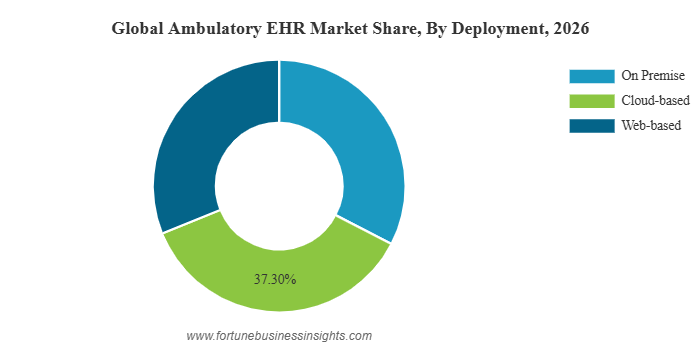
The market is segmented into on-premise, cloud-based, and web-based solutions.
The cloud-based segment dominated, accounting for 37.30% share in 2026, due to scalability, cost efficiency, improved security, and interoperability. Cloud-based EHRs also support AI integration, predictive analytics, and telehealth services.
By Application
Applications include clinical documentation, appointment management, e-prescribing, clinical decision support, remote patient monitoring, billing, analytics, and others.
The clinical documentation segment led, contributing 19.70% share in 2026, driven by widespread adoption across hospitals and clinics and increasing investment in AI-driven documentation tools.
By End User
End users include ambulatory centers, specialty clinics, and others.
The ambulatory centers segment dominated, accounting for 57.46% share in 2026, due to high patient volumes and the need for efficient scheduling, billing, and documentation systems.
Future Overview:
Expansion of AI-Driven Clinical Intelligence
Future ambulatory EHR solutions will increasingly embed advanced artificial intelligence capabilities such as predictive analytics, clinical risk stratification, automated coding, and personalized treatment recommendations. AI-powered decision support is expected to improve diagnostic accuracy, optimize care pathways, and reduce administrative burden in high-volume outpatient environments.
Growth of Ambient and Voice-Enabled Documentation
The adoption of ambient clinical documentation and conversational AI is expected to accelerate significantly. These technologies will enable real-time, hands-free documentation during patient encounters, allowing clinicians to focus more on patient interaction while improving data quality and workflow efficiency.
Ambulatory EHR Market Regional Outlook
North America
North America accounted for USD 4.48 billion in 2025, supported by strong healthcare infrastructure, favorable regulations, and rapid AI and cloud adoption. The U.S. continues to lead the regional market due to early technology adoption and robust outpatient care expansion.
Europe
Europe is projected to grow at a CAGR of 5.85%, driven by rising investments in cloud-based and AI-integrated EHR platforms. The U.K. and Germany are key contributors to regional growth.
Asia Pacific
Asia Pacific is the third-largest market, driven by government-led digital health initiatives and growing adoption of mobile and cloud-based EHR solutions in China, India, and Japan.
Latin America and Middle East & Africa
These regions are expected to witness notable growth, supported by expanding healthcare infrastructure, rising outpatient facilities, and increased public-private investment in healthcare IT.
Speak to Analysts: https://www.fortunebusinessinsights.com/enquiry/speak-to-analyst/ambulatory-electronic-health-record-market-100620
Competitive Landscape
Key Industry Players
The market exhibits a semi-consolidated structure with leading players such as Epic Systems Corporation, Oracle, Medical Information Technology, Inc., and TruBridge holding significant market share. Companies are focusing on mergers, acquisitions, and partnerships to enhance platform capabilities and market reach.
List of Key Ambulatory EHR Companies Profiled:
Epic Systems Corporation
Oracle
Medical Information Technology, Inc.
TruBridge
Veradigm LLC
Azaleahealth
MEDHOST
Netsmart Technologies, Inc.
Greenway Health, LLC
Key Industry Developments
September 2025: Athenahealth launched AI-powered EHR enhancements under athenaOne.
June 2025: MEDITECH expanded Expanse EHR across 132 clinics with Willis Knighton Health.
February 2025: Athenahealth partnered with Abridge to enhance generative AI documentation.
January 2024: Harris Computer Corporation acquired MEDHOST to expand healthcare IT offerings.
December 2021: Netsmart acquired Remarkable Health to accelerate AI-driven EHR innovation.
Future Scope of the Ambulatory EHR Market:
The future of the ambulatory EHR market is expected to be shaped by rapid technological advancement, evolving care delivery models, and increasing demand for data-driven outpatient services. As healthcare systems continue to decentralize, ambulatory EHR platforms will move beyond record-keeping to become intelligent, interoperable care orchestration systems.
Ashwin Arora
Fortune Business Insights™ Pvt. Ltd.
+1 833-909-2966
sales@fortunebusinessinsights.com
Legal Disclaimer:
EIN Presswire provides this news content "as is" without warranty of any kind. We do not accept any responsibility or liability for the accuracy, content, images, videos, licenses, completeness, legality, or reliability of the information contained in this article. If you have any complaints or copyright issues related to this article, kindly contact the author above.
